DILLON COUNTY’S CONTRIBUTION TO AMERICAN INDEPENDENCE TO BE RECOGNIZED BY SERIES OF HISTORICAL MARKERS
BATTLE OF ROUSE’S FERRY TO KICKOFF CELEBRATION OF DILLON COUNTY’S IMPORTANCE IN THE AMERICAN REVOLUTION ON DECEMBER 15 AT 2PM
By James E. Lockemy
In 1780, the British were tired of the stalemate with George Washington and his Continental Army in the northern part of America. The decision was made to take the war South where it was thought many were loyal to the Crown and would join in the fight to finally end the Revolution that had been going on for 5 brutal years.
So in May of 1780, the British captured Charleston, South Carolina and over 5000 American troops surrendered. This was the largest defeat so far for the American cause during the Revolution. Col Abraham Buford was on his way with Virginia Continental Troops to help when he heard of Charleston’s surrender. He turned back but Colonel Banastre Tarleton’s cavalry was dispatched by British Commander Lord Cornwallis to pursue and defeat him. Tarleton caught up to him in late May,1780, and defeated him. According to many accounts Tarleton slaughtered Buford’s troops as they attempted to surrender.
Washington had already sent General Horatio Gates south with an army when he learned of Buford’s Massacre. Surely, Gates would be victorious and restore American momentum in the war. Unfortunately, Gates and his entire army were routed at the Battle of Camden in August 1780.
In response to these rousing victories, loyalists in large numbers all over the eastern half of South Carolina rose up as they saw at last a chance to defeat the Patriots that had held them back up until the arrival of the British Army and Navy. It was indeed a crucial and sad time for America as it appeared the British Southern strategy was going to work and the cause for American Independence crushed.
The British and the Loyalists did not count on a response from Patriots all over South Carolina but particularly in the Pee Dee region. Under command of Francis Marion who had escaped capture as he had been temporarily away from Charleston when it surrendered and militia leaders in the Georgetown District which stretched from modern Chesterfield County to Georgetown with Dillon County right in the middle a rag tag force of farmers and artisans assembled to resist the British and newly confident Loyalists. These Patriots assembled and pledged to fight against all odds to keep the hope of American Independence alive.
Washington sent Nathaniel Greene to the South to raise an army to battle the British but in the meantime, patriot militia would have to fight loyalist militia alone in battles that would decide the fate of not only South Carolina but the war.
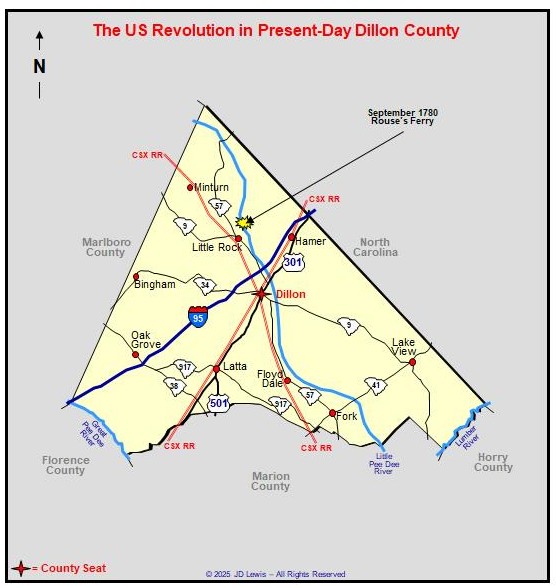
The first of these battles occurred in Dillon County shortly after Buford’s Massacre and the defeat at the battle of Camden with America badly needing some good news. The area around Rouse’s Ferry on the Little Pee Dee was a hotly contested area. The Loyalists felt bolstered by the previous British victories and thought they could now subdue the local Patriots who were often comprised of their own family members and neighbors. Fighting was brutal and often without mercy. It was truly a civil war.
One example of this is the effort to rob and kill William “Sweat Swamp” Bethea. Loyalists heard that he sympathized with the Patriots and often had lots of money at his cabin. They broke into his home, tortured him by many means including pouring hot pitch tar over his head but he still would not reveal the whereabouts of his money. They finally gave up and left him severely injured at his home where his son, John Bethea, found him. John swore that he would find those responsible and get revenge.
Rouse’s Ferry was also a key supply point. Local farmers herded many cattle to the Little Pee Dee at that point where many were sent on down the river to connect to the Big Pee Dee and Black River on to the Ashley Cooper and Charleston. Supplies to the west came back the same way and were unloaded at Rouse’s Ferry. Controlling it would be important for both sides. In September 1780, although the outlook was extremely bad for them, Patriot militia under the command of Captain Clayburn Hinson decided to raid the area and take cattle from the Loyalists and control the Ferry. Although we do not know the exact number of casualties, we do know that Patriot Lieutenant Jarrat Whittington was severely wounded. The battle resulted in a Patriot victory. For the first time since May of that year the Patriot cause had some good news. Not only had cattle been acquired for hungry troops but British supply lines had been disrupted, and Loyalists were prevented from consolidating their troops causing the British regular army to divert resources and manpower to protect outposts in the Pee Dee. Rouse’s Ferry put positive morale back within Patriot lines and gave renewed hope to the cause for independence. It was followed up by several other Patriot victories in Dillon County but also major contests including Black Mingo Creek, Georgetown and the final major battle in the area at Eutaw Springs.
Over the next year, here in Dillon County, we are going to highlight this County’s contribution to the winning of American Independence as a major component of South Carolina’s enormous involvement that ran the British north until they were bottled up in Yorktown and surrendered in October 1781, leading to the eventual British defeat. We will visit Battle of Bear Swamp near Lake View later in 1780, the Battle of Hulin’s outside of Latta in 1781 and finally one of the first recorded incidents of PTSD at the Killing of Courtney off of Highway 38 as the war was ending.
It all begins with Rouse’s Ferry where present day Harllee’s Bridge is located. Come join us as officials from the South Carolina 250th Commission join local officials and your Dillon County 250 Committee to celebrate this important Patriot Victory with the unveiling of a marker at the site. This will take place on December 15, 2025 at 2pm. We will celebrate the victory, extoll the importance of the Pee Dee and South Carolina in winning the independence of the United States of America. We will have a few other surprises for you, A nice little reception will follow. All patriotic Americans are invited (even if your ancestor may have been loyal to King George!) Hope to see you there.
By the way, John Bethea did avenge his father. He captured some of the perpetrators and turned them over to authorities. He decided to hang one particular ringleader named Snowden. As he commenced to hang him with a horse bridle, he realized that Snowden was too heavy and tall. Bethea could not lift him high enough off the ground for the bridle strap to perform the horrible act. Bethea decided to break both his legs. Now Snowden could not stand and he proceeded to hang him. From then on, he was known as “Devil John” Bethea. His grave is not far from the Battle of Rouse’s Ferry in which he and his father took part.
Hope to see you on December 15, 2025, 2pm at Harlee’s Bridge, Little Rock, Dillon County, South Carolina.
GPS address is: 1884 Harlee’s Bridge Road, Little Rock, South Carolina