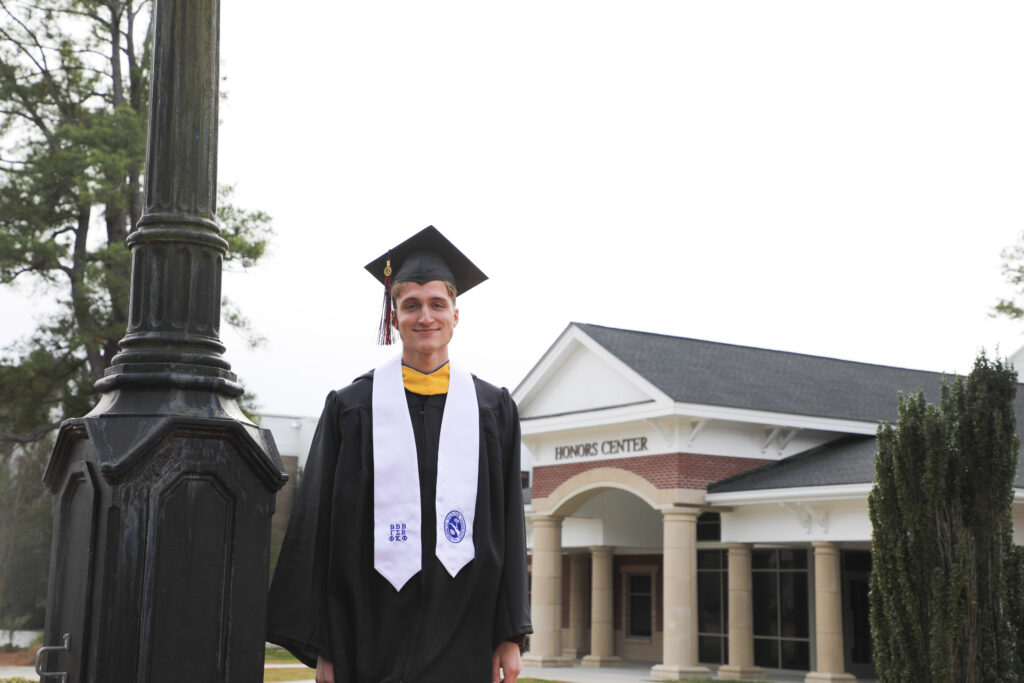
For Latta native Jacob Edwards, Francis Marion University has been the perfect place to pursue his degree and gain the support needed for his next step: a doctoral program in Biochemistry.
A Biology major with a minor in Chemistry, Edwards has embraced every moment of his FMU experience. A Darla Moore Scholar, he chose Francis Marion because of its distinguished faculty, research opportunities, and the close-knit community.
When Edwards arrived on campus in the fall of 2022, he had his eyes set on becoming a medical doctor. After spending time shadowing and volunteering at local hospitals throughout high school and college, that path seemed certain. But everything changed during the fall semester of his sophomore year when he took his first glimpse into the world of scientific research. That semester, Edwards joined a project led by Dr. Jennifer Lyles, associate professor of biology, examining adeno-associated viral vector genomes. The experience reshaped his goals.
Since then, Edwards has immersed himself in research, presenting at multiple regional and national conferences. A highlight of his undergraduate career was his presentation, “The Effect of Cellular Differentiation on Adeno-Associated Viral Vector Genome Status,” delivered at the national meeting of the American Society of Biochemistry & Molecular Biology in Chicago this past April. That experience, he says, was “life changing.”
“Attending and presenting at the national meeting of the American Society of Biochemistry & Molecular Biology was an incredible experience,” says Edwards. “At this conference, I was able to hear from experts at the top of these fields and was exposed to new research areas. I also had the opportunity to network for graduate school.”
His work extended well beyond a single project. As a research assistant to Dr. Kristofoland Varazo, professor of chemistry, Edwards helped develop environmental chemistry lab curriculum focused on quantitative analysis. Under Dr. D. Allen Clabo, professor of chemistry, he explored computational physics and transitional metal bonding, gaining experience across diverse areas.
Edwards’ research journey continued beyond FMU’s campus. This past summer, he received an undergraduate research fellowship from the National Science Foundation and spent ten weeks at the University of Notre Dame working with Dr. Xin Lu, professor of biology. There, he studied neuroendocrine prostate cancer, an extremely rare and aggressive variant resistant to traditional treatments. This experience was deeply meaningful to him.
“Through the research I’ve had the opportunity to participate in on campus as well as at Notre Dame, I’ve discovered that I have a passion for biochemistry and research specifically related to molecular dysfunction and cancer systems,” says Edwards. “Having grandparents who both had cancer initially spurred my interest in this type of research, which has been solidified through the incredible opportunities I’ve had at FMU.”
With unofficial offers already in hand from several top research universities across the country, Edwards will determine in the spring where he will begin his Ph.D. studies. No matter where he goes, he credits FMU with preparing him exceptionally well.
“I cannot say enough about the faculty of FMU,” says Edwards. “The relationships I’ve formed with my professors have given me so many opportunities to do work outside of the classroom, further preparing me for graduate school and my future. They take a real interest in their students and have always been willing to help and give extra resources when there’s a topic I’m interested in that isn’t part of the regular curriculum. That’s something I think is rare.”
Outside the classroom and lab, Edwards has been heavily involved in campus life. He participated in numerous student activities, was a member of the Pre-Health Club and FMU Honors, worked as a tutor in the Tutoring Center, and has served as a marshal since 2022. He is also a member of Tri-beta Biological Honors Society, Gamma Sigma Epsilon Chemical Honors Society, and Phi Kappa Phi National Honors Society.
For Edwards, FMU has been a transformative experience academically, professionally, and personally.
“I love FMU,” says Edwards. “I began college with quite a few credits and could have graduated earlier, but I wanted to stay and continue to learn and grow.”
As he awaits final word on his next academic home, one thing is certain: wherever Edwards continues his studies, he will carry with him the knowledge, experience, and support that FMU has provided, preparing him not only for graduate school, but for a lifetime of scientific discovery.